Does the Persona 4 Cast See Each Other Again
Persona 4 Arena , besides known as Persona 4: The Ultimate in Mayonaka Arena in Japan, is a 2D fighting game by Arc System Works, developed under the supervision of Atlus's P Studio. It is directed past Katsura Hashino and scored by Shoji Meguro.
It is a spin-off to both Persona 3 and Persona four, set immediately after the events of Persona 4, featuring characters from both games. Equally such, it is strongly recommended to finish both Persona 3 and Persona 4 kickoff, or else Arena will spoil major plot points from both games.
A sequel, Persona 4 Loonshit Ultimax, was released.
Contents
- 1 Plot
- 2 Characters
- 2.ane Additional Grapheme Dates
- 3 Gameplay
- three.1 Console Release
- 4 Gallery
- 5 Trivia
- 6 References
- 7 External links
Plot

Persona four Arena E3 Trailer
Trailer.
The game contains twelve different story modes from each of the bandage members. The selected character acts as the game'south protagonist, and the story of the game is told through their perspective via visual novel cutscenes, with the upshot affected past the graphic symbol chosen. Still, Labrys (whose story is a visual of her past) and Shadow Labrys (who does not have a story mode) are not acting protagonists. The following is a general summary based on all the story modes:
The story starts 2 months afterward the events of Persona 4 but earlier the epilogue of Persona iv Golden, meaning that Arena is fix in May 2012.
At the start of Golden Week, Yu Narukami returns to Yasoinaba and reunites with Dojima, Nanako and his friends. But presently Chie hears a rumor that the Midnight Channel is airing again and tells Yosuke and Yukiko. The iii of them and Yu (coincidentally) see it. At the same time, Ascent, Kanji and Teddie go missing and Naoto is busy on a mission. The following solar day, they caput into the Television receiver world and find themselves stuck in a tournament held at their high school where they must fight each other to advance, only during the tournament they see a mysterious girl who claims to be their pupil council president as well as three Persona-users they've never seen before.
Mitsuru is now head of a hugger-mugger spec ops squad known as Shadow Operatives working with the government consisting of herself and some of her erstwhile SEES colleagues. On a mission to escort tiptop secret cargo, the airplane she's on is hijacked. Aigis manages to accept downwards all the hijackers on her own but 1 of the cargo is stolen: the 5th generation anti-Shadow humanoid weapon, Labrys. They track her down to Yasoinaba and enter the TV world, joined by Akihiko Sanada, having just arrived from South America, who shows up to help after Aigis picks upwards readings from inside. Naoto is hired by public safety to spy on the Kirijo Group and Shadow Operatives. She follows them into the Television.
As Elizabeth continues on her journey, she stops by at the gate of death to defeat Erebus, who comes back about once a year (she picks it up with 1 hand, throws it through a portal to the moon, then kills information technology in ane striking with Thanatos). She heads over to the Television set earth when she feels all the Persona users gathering there, hoping that she may observe something in the strange miracle may be able help her to defeat Erebus for good so that she could save the boy who became the seal to protect humanity. Elizabeth encounters ii of the male child's successors, one that she had befriended and given the Velvet Room's guidance nether her supervision, and some other who had also received the Velvet Room's guidance simply this fourth dimension under Margaret'south supervision.
As the Persona users become to the Announcement room where Rising is being held, they discover Labrys and soon learn almost her equally her Shadow reveals her true self.
Labrys was created in 1999 at the Kirijo Ergonomics, lab and virtually of her evolution was done through forcing her to fight other models of her series. She grew close to 1 of her "sisters", Unit of measurement 024, only was forced to destroy her also. She eventually escaped the lab, dealing extensive damage to information technology in the process, but was recaptured and sealed away. After vanishing from Mitsuru's plane, she was tossed into the TV world and her Shadow Self created the tournament to let other people feel what she felt.
The Persona users defeat Shadow Labrys and Labrys accepts her, turning the Shadow into her Persona, Ariadne. Every bit they prepare to leave, even so, the truthful mastermind behind everything takes command of her and makes her assault everyone. Fuuka manages to reach Yasoinaba in time and cut off his connection, just he escapes. The mastermind is a human with no Persona who cannot enter the TV world, simply is partnered with something inhuman that can shape shift and pretends to exist various characters' Shadows. Their objective is to weaken the Persona users mentally then that their Personas will revert dorsum to Shadows; they need to gather potent Shadows for their "Project", and reverting the Persona users' strong Personas would make exceptionally stiff Shadows. Both of them escape, and Mitsuru tells Inaba's Persona users to forget almost everything and leave the rest of the case to them. Yu convinces everyone to "comply" with Mitsuru'south society, but she and Aigis easily see through his deed. Regardless, they determine to let them do what they want, though both also plan to do everything they tin to go along them out of impairment's way. Before they leave, Labrys meets up with the Inaba group again and tells them that she will exit and bring together with Mitsuru'due south group to grab the culprit and so that she can protect her new friends, while she and Aigis vow to find their "female parent".
Later they get out, Yu and Yosuke tell anybody that they are reforming the Investigation Team. Everyone prepares for what comes side by side.
The penultimate boss in most character's story mode is Shadow Labrys. The final dominate of the Persona 4 cast is a brainwashed Labrys with Ariadne. The final bosses of the Persona three characters and Naoto is their own fake Shadow. In Teddie's instance, he has an actress fight against Kanji who thinks everything is a dream and shows up looking for a fight.
Elizabeth's Story Mode ends with her gaining insight on the nature of the Wild Bill of fare from Yu and Aigis, and she gains her own Fool Arcana, signifying the start of a journey.
In improver, Yu, Chie, Yukiko and Kanji are given choices in specific parts of their story where they are given prompts to respond to. For Yu, this is has no bearing on his story (though specific choices can lead to an extra scene with Margaret). For the others, their choices can either lead them to their true ending, or a non-canon joke ending.
Characters

Several members of the cast from Persona 4
- Main commodity: List of Persona iv Arena Characters
As a sequel to Persona 4, the game sees a return of the original cast every bit well every bit several characters from Persona three. Each of the principal characters were also given titles.
- Yu Narukami: The Sis Complex Kingpin of Steel (鋼のシスコン番長, Hagane no Shisukon Banchō) ? . "Sister Complex" references Yu's dear for his cousin Nanako Dojima—also known as "Nanakon" (ナナコン) in Japanese fandom. "Kingpin" may be a reference Yu'south fan nickname in the Japanese fandom (Banchō).
- Yosuke Hanamura: Helm Ressentiment (キャプテン・ルサンチマン, Kyaputen Rusanchiman) ? is a reference to Yosuke's resentment towards a guild that hates him for being the son of a man that destroyed business for the Fundamental Shopping District.
- Chie Satonaka: Spunky Dragon with Deadly Legs (男勝りの足技系ドラゴン, Otoko-masari no Ashiwaza-kei Doragon) ? , translated literally as "the dragon with leg martial skills who surpasses all males." Her title in the original promotional video is The Carnivore Who'southward Discarded Womanhood (女を捨てた肉食獣, Onna o Suteta Nikushoku-jū) ? , a reference to her undying consumption of meats and beingness a fan of martial arts.
- Yukiko Amagi: The Unconquerable Snowfall Blackness (難攻不落の「黒」雪姫, Nankō Furaku no "Kuro"-yuki-hime) ? is both wordplay of "Snow White," due to Yukiko's proper noun meaning "snowfall," and a reference to Yukiko's Castle. "Black" also refers to her hair color and a Japanese stock character known as "haraguro" (腹黒), who talks amicably but has some weird or cruel ideas in mind.
- Kanji Tatsumi: The Appalling Beefcake Emperor (戦慄のガチムチ皇帝, Senritsu no Gachimuchi Kōtei) ? , a jab at his sexual insecurities. Gachimuchi is a Japanese slang term, referring to very masculine homosexual men.
- Teddie: The Beast in Heat (色欲の猛獣(ビースト・オブ・リビドー), Bīsuto obu Ribidō) ? . The kanji translates literally to "Predator of Sexual Desires," and the furigana translates to "Beast of Libido". It is a reference to his repeated attempts to hook up with the female members of the Investigation Team.
- Naoto Shirogane: The 2000 IQ Killjoy Detective (IQ2000のKY探偵, Ai Kyū Nisen no Kē Wai Tantei) ? . "KY" is a Japanese slang abbreviated from the phrase "(kūki ga yomenai, 空気が読めない) ? ," which means someone acting improperly in the wrong situation. Yosuke uses this slang on Naoto during their schoolhouse trip to Tatsumi Port Isle in the club in the Japanese version.
- Akihiko Sanada: The Ii-Fisted Poly peptide Junkie (剛拳のプロテインジャンキー, Gōken no Purotein Jankī) ? refers to his boxing career and his dearest of protein.
- Mitsuru Kirijo: The Imperious Queen of Executions (孤高の処刑女王, Kokō no Shokei Joō) ? , a reference to Mitsuru's ice executions. Too possibly a reference to the failed Kyoto minigame scene.
- Aigis: The Heartless Armed Angel (全身凶器の心なき天使, Zenshin Kyōki no Kokoro-naki Tenshi) ? , a reference to her being a humanoid android with heavy weaponry.
- Labrys: Yasogami's Steel Quango President (八高・鋼鉄の生徒会長, Hachikō Kōtetsu no Seitokaichō) ? , a reference to her being an android and the Educatee Council President.
- Shadow Labrys: The Raging Bull of Destruction (皆殺しの猛牛総統, Minagoroshi no Mōgyū Sōtō) ? , a reference to her familiar Asterius and her want for destruction.
- Elizabeth: The Lethal Elevator Attendant ((史上)最凶のエレベーターガール, (Shijō) Saikyō no Erebētā Gāru) ? refers to her previous role as Igor'south assistant in the Velvet Room, which in Persona 3 took the grade of an elevator.
Additional Character Dates
The Japanese Arcade versions had additional characters that were released overtime.
- Labrys: March 22, 2012
- Elizabeth: April 5, 2012
- Shadow Labrys: Apr 19, 2012
- Yukari Takeba: Location Exam from August sixteen to August 18, 2013
- Junpei Iori: Location Test from Baronial 16 to August 18, 2013
Gameplay
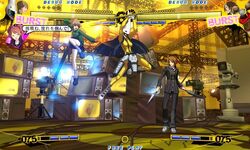
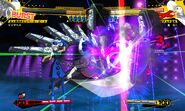
Chie Satonaka and Yosuke Hanamura in gameplay; showing the first HUD displays in the initial build of the game.
Persona 4 Loonshit follows the style of modern anime fighters, in the same vein of ones developed by Arc Arrangement Works past largely building upon the engine used for BlazBlue (idea with some aspects of Guilty Gear mixed in). In addition, many fighting game elements of Persona 4 Arena have been streamlined in comparison to its peers such as simpler controls. However, one notable trait is that this fighting game puts very heavy accent on the avatar/summon/puppet-based system, in that two different characters are to be controlled.
The controls of gainsay consists of 4 buttons: A (Light/Weak Assault), B (Strong Attack), C (Persona Attack) and D (Persona Blitz) and motility input via stick, d pad, or otherwise. A combination of the buttons consequence in other functions like the Furious Action. Special moves (or Sure-Killing Arts in Japanese circles), which are universally known every bit Skill Attacks/Skills in this game, are performed by the correct motion and push input. Special moves and supers, can inflict chip damage when they are blocked (a pocket-sized amount of percentage of its original impairment on hitting), only in the former case they tin can build a pocket-size amount of SP/meter if they miss/are whiffed.
Through a number of very recent fighting games made around the aforementioned time as P4U, an Auto-Combo tin can be performed by repeatedly pressing A in a neutral position in lodge to appeal to beginners, which is known every bit the Renda Combo (lit. Avalanche Combo) in the Japanese versions. The second and 3rd inputs are alternating unique "dial-philharmonic" normals which tin can be cancelled other higher-tiered moves freely. The 4th and 5th inputs are instead, a preset Skill to Super Cancel followup. 15 actress SP and a fleck of the Outburst Gauge is rewarded for a successful three-input Barrage Combo, and the full car-combo can but occur if all attacks connect on striking. Nevertheless, not all characters' automobile-combos can be cancelled freely into other attacks outside of their preset route.
Personas in this game act as a passive-avatar arrangement; moves are used to call them out only for a cursory activeness earlier they disappear. If either the users or their Personas are struck during any Persona-based action, they volition instantly vanish and a Persona card will exist depleted. Once all Persona cards are depleted, a Persona Intermission can occur. A Persona Break will occur barring the usage of the target's Persona for a set up amount of fourth dimension, though Persona-based moves can be done right after when hit (even when a Persona Pause occurs).
Additionally, each character has their own reversal referred to every bit a Furious Action (known equally the Reversal/R-Action in Japanese). Equally the name implies, they are defensive special moves that let the character to overturn the tide of battle like having an anti-air motion with invincibility frames or a counterattack. Furious Activeness converts the thespian'southward life into blue life which can be healed over time equally long every bit the thespian is not hit; overall, blue life is a unique mechanic new to fighting games in full general, where it allows for taking chip damage at 1 HP to not impale a player. 5% of ane's HP is converted into blueish health whenever the aforementioned Super Cancels are performed.
Persona iv Arena as well has its own variation of an All-Out Attack that tin can exist performed, and followed up with a new mechanic called an All-Out Rush, a mini version involving only one character. This functions as a universal overhead set on with autoguard/guard indicate backdrop and an boosted input if the initial overhead connects, which causes stagger on grounded striking or a wildly-flung basis bounce on air hit; if the former hitting effect successfully occurs, so the All-Out Blitz allows for the player to knock foes away or launch them into the air depending on the followup input, all with button mashing for extra hits and a free Fatal Counter hitting.
Imported from the Persona serial in general are Status ailments. Condition ailments last a certain amount of time and are also negated if the user is striking. The but exception to this is Rage/Berserk, which simply goes abroad subsequently a set corporeality of time. Only one status ailment tin can be in consequence at a time, and can be cancelled out past some other.
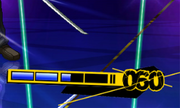
The SP Gauge.
Like in the series, SP is a resource that tin be expended to execute various moves with the relevant input and SP amount. Such commands involve Skill Boosts (a.grand.a. EX Moves) SP Skill Attacks (a.g.a. Supers/Super Certain-Killing Arts), Guard Cancels, and One More! Cancels (a.grand.a. Roman Abolish/Rapid Abolish; ends current assault animation equally long as the set on connected).
Characters can perform difficult-to-land Mortal Blows/Instant Kills which instantly defeats the opponents. They can only be performed on match point, and it consumes 100 SP.
When a character's life is 35% or less, they enter an Awakening Land, signified by a red SP Estimate and a Persona-style summoning cut-in in the groundwork. In this state, the SP Gauge is extended to 150 and gains an extra l immediately, the character gains a defence boost, and enables a new Super or two exclusive to that state, similar to certain desperation modes in past fighting games. It is possible to enter Awakening Land through blue wellness.
Below the Life Gauge is a Burst Gauge. When total, the player tin can Burst, which blows back the opponent with invincibility frames if they are in close proximity. When it is used when your opponent is hit and you are in neutral position, your SP Gauge maxes out and your Burst Judge takes less time to refill. If it is used when the thespian is attacking, information technology causes a One More! Burst, an un-techable launcher that up-scales damage following it. If it is used while the role player is in hitting stun, bursting has no benefits other than peeling the enemy off the role player. All Bursts count as Persona moves, thus if the thespian cannot employ their Persona, via Persona Interruption or Silence, they cannot burst.
Other notable functions involve Evasive Actions, forward moving dodges with hit invincibility akin to rolling, Hops, Teching/Ukemi (Passive Falling), Air Turn (a universal mechanic new to fighting games), and a universal Sweep (alike to Guilty Gear merely not like other fighting games where sweeps are crouching normal attacks).
Console Release
The console release of Persona 4 Loonshit is split between several different game modes. Lesson Mode teaches the actor basic and avant-garde system mechanics inside the game. Story Way follows the story of Persona four Loonshit through each of the character'south perspectives. Arcade Mode is the arcade release of the game and serves every bit an abridged version of the game's Story Manner. Score Attack Style is a much harder Arcade Way where the player goes through every character in the game on a special difficulty setting that is more intense than Hell difficulty. The characters are fought in the following order, regardless of player character: Yosuke, Naoto, Yukiko, Teddie, Kanji, Chie, Mitsuru, Akihiko, Aigis, Yu, Shadow Labrys, Labrys and Elizabeth. Each character as well has a specific ready of changes that make them more boss-like to increase the difficulty even farther. Afterward every four characters defeated, the next iv will have a more ambitious AI than the previous, which also increases the difficulty over time.
| Grapheme | Score Set on Mode Details |
|---|---|
| Yosuke Hanamura | Sukukaja: Permanently agile AI Aggression: High |
| Naoto Shirogane | Fate Counter: Now lowered by all attacks AI Aggression: High |
| Yukiko Amagi | Burn down Interruption: Permanently active Fire Amp: Permanently at Level eight Fan moves are thrown 3 at in one case. AI Aggression: High |
| Teddie | Circus Bear: Teddie now runs across the screen 3 times instead of 1, harm and speed roughly doubled AI Assailment: High |
| Kanji Tatsumi | Take hold of attacks now do roughly triple damage Gains a new special motility, a very fast dropkick with super armor AI Aggression: Very Loftier |
| Chie Satonaka | Ability Charge: Permanently at Level 3 AI Aggression: Very High |
| Mitsuru Kirijo | All attacks at present cause either Freeze or Charm status AI Assailment: Very High |
| Akihiko Sanada | Cyclone Gauge: Permanently at Level 3 Electrical Fists: Permanently agile AI Aggression: Very High |
| Aigis | Orgia Mode: Permanently active and unlimited meter Megido Fire EX: The flames hit thrice as much earlier throwing the target back into the ground Ammo count increased to 999 AI uses Heritage Liberator Palladion (Depression Probability) AI Aggression: Extremely High |
| Yu Narukami | All attacks can now be canceled into each other Electric attacks accept a higher probability of inflicting Stun AI uses Myriad Truths (Low Probability) AI Aggression: Extremely High |
| Shadow Labrys | Doubled overall damage output AI uses Labyrinthos Gate (Medium Probability) AI Aggression: Extremely Loftier |
| Labrys | Axe Estimate: Permanently at maximum level (red-colored axe) AI uses Weaver'southward Art: Inquisition (Medium Probability) AI Aggression: Extremely High |
| Elizabeth | HP: Increased from 7500 to 22500 Invigorate: SP gain rate increased by roughly quadruple Diarahan: HP now fully regenerates Mahamaon & Mamudoon: Now actuate instantly, no longer requiring a timer Ghastly Wail: Impairment increased to 7500 normally, and 44444 if the opponent has Fear status inflicted on them (instant expiry) AI uses Megidolaon, but now activates with but 1 hit instead of iii (High Probability) AI Assailment: Ultimate |

The 1.02 patch icon.
Versus Mode is the local multiplayer mode. Network Mode is the online multiplayer mode divide between Ranked Matches and Player Matches. Finally, Challenge Mode has the player going through each character'due south moves from basic commands to basic combos to avant-garde combos, the last challenge being a test of how they understand a certain character's moves or hitting an extremely high combo to produce a high impairment count.
The original arcade version somewhen has received patches that included characters from time to time, simply eventually for both the arcade and console versions, a one.02 patch came with slight balance tweaks to the system mechanics, small bugs, and all characters, and is identified with a small icon on the lower right of the screen. Thus, on console information technology is technically impossible to play 1.00 and 1.01.
Gallery
- Boxart

Japanese Boxart
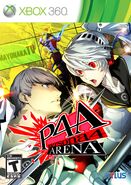
North American Xbox 360 boxart
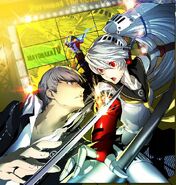
Boxart
- Screenshots
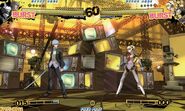
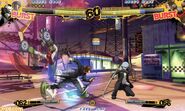
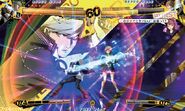
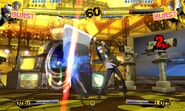
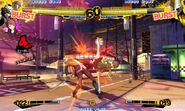
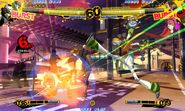
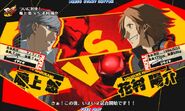

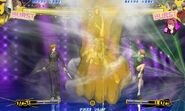
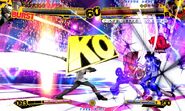
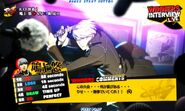
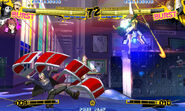
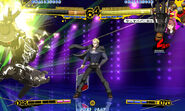
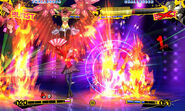
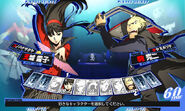
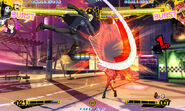
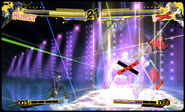
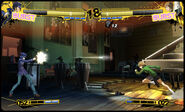
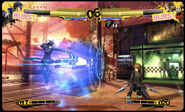
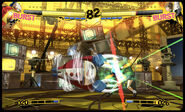
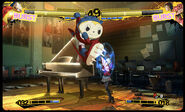
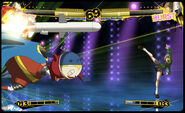

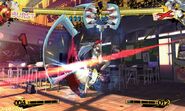
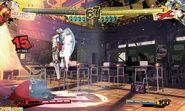
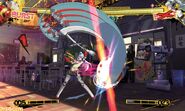
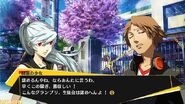
Story Manner
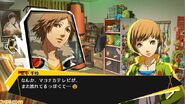
Story Mode

Story Fashion
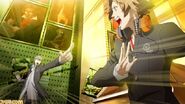
Story Manner

Story Mode
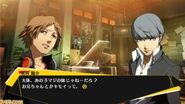
Story Way
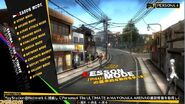
Main Menu

Anime cutscene, story fashion
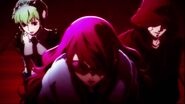
Opening Cutscene
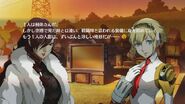
Mitsuru and Aigis

Teddie speaking to Akihiko
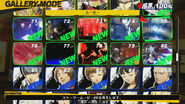
Gallery Fashion
- Artwork and Sprites
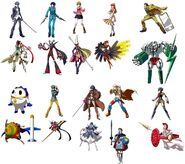
Costume based on various Persona characters
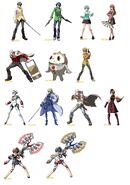
Extra DLC palettes
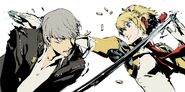
Artwork of Yu and Aigis
Trivia
- P4U is the first game to not characteristic the Shin Megami Tensei label in its overseas championship, ever since Shin Megami Tensei: Nocturne was localized in N America and Europe.
- P4U is the commencement title in the Persona serial to be released on Microsoft'south Xbox gaming hardware.
- P4U's story takes place in spring 2012 - the same yr the game'due south Arcade version was released.
- Despite dropping "The Ultimate in Mayonaka" from the game's title outside of Nihon, the original proper name appears in the intro movie in all regions. Similarly, the default organisation voice will always refer to Teddie by his Japanese proper name of Kuma, even when the language is set up to English.
- Also, a direct translation of the Japanese proper noun of the game would exist Persona iv: The Ultimate in Midnight Arena.
- In about official cloth, the game is abbreviated as "P4U" in both Japanese and English to not merely refer to the "Ultimate" in the Japanese championship, but to forestall information technology from being mixed upward with Persona 4: The Animation, in which both The Animation and Arena via English localization can exist abbreviated as P4A.
- Despite taking place after Persona 4, the Investigation Squad are shown with their initial Persona, instead of their ultimate ones different Mitsuru and Akihiko, too as Aigis being shown still using Pallas Athena. This, nonetheless, can hands exist explained equally obtaining their ultimate Persona is optional in Persona 4. Also, since Aigis and Yu are both users of the Wild Card, they may have merely recreated Izanagi and Pallas Athena through fusion. Nonetheless, this still does not explain why Teddie does not have his canon Persona, when information technology transfigured into its ultimate form, Kamui, by unlocking the proficient catastrophe of Persona 4. It is possible the Investigation Team don't accept their ultimate Personas considering Persona 4 Golden has them acquire new third tier Personas, probable to arrange people who haven't played P4G & wouldn't have gained the new Personas. Aigis may also have Athena instead of Orpheus for similar reasons, to accommodate players who haven't played The Reply.
- Yu, still, uses Izanagi-no-Okami during his Instant Kill, and Aigis uses Palladion (albeit heavily modified) during hers. In Aigis' case, she oddly de-evolves her Persona instead of evolving it.
- Interestingly enough, each grapheme has voice clips in their sound exam of them calling the names of their initial and ultimate Personas. Information technology was probably intended for each grapheme to choose between their Personas but, probably due to time constraints, this was cut.
- Arc System Works originally wanted Ryotaro Dojima every bit ane of the playable characters during the pre-planning stages when they were deciding on the bandage. Takumi Iguchiya joked that instead of a Persona, he would summon Nanako Dojima to his aid, maybe ending up as a joke character.[two] Nanako herself was then proposed as a playable character, but both decisions were strongly rejected by Atlus.[3]
- Persona iv: Arena is the first non-BlazBlue fighting game to apply the Fatal Counter system, also every bit the first to brand use of an un-tech timer exterior of training fashion. [citation needed]
- This is also 1 of the first fighting games to make utilize of a universal auto-philharmonic system that involves pressing a unmarried button to perform an automatic 5-input philharmonic for beginners. Other fighting games fabricated aslope P4U'due south time involve this very type of system besides which has carried on to future fighting games.
- This is also the first fighting game to besides count the very first hitting in a philharmonic; nigh prior fighting games have instead counted from the second hit onward.
- This is one of three PlayStation 3 games to be region locked.
- A majority of characters in this game have skills/spells either used without a Persona, or skills/spells not learned by their Persona(s) naturally. Some also do not retain certain skills used past their Personas in their original games as well.
- Yu'south Izanagi cannot learn Ziodyne and Swift Strike, but it'due south possible in Yu'south case as the main character in the original Persona 4 and Persona four Gilded through fusion to re-create an Izanagi with both those skills.
- Yosuke uses Garudyne in the style of his follow-upwardly attack.
- Chie uses Rampage without the use of a Persona (in the style of her critical hitting), as well as Skull Cracker. Her Instant Kill is also her original follow-upwards attack.
- Likewise, she oddly does not accept any ice-based spells in her movement set, though she eventually gains an ice-based move in Persona iv Arena Ultimax.
- Kanji as well uses Brutal Assail without his Persona (in the style of his follow-up assault), and was the simply SMT series skill in his move fix until Ultimax added in Central Forcefulness. Kanji'south critical hit animation as well acts equally one of his SP Skills.
- Teddie has no SMT series skills and just has his original follow-up assault as 1 of his special moves. He eventually gains Nihil Hand from his Shadow's repertoire of skills in Ultimax.
- Naoto's is a bit of an inversion, for her Seigi no Tate (Shield of Justice) R/Furious-Action from this game eventually becomes a skill for her new Persona, Yamato Sumeragi in Aureate.
- However, she uses Megido in the style of a hair-trigger bomb, and she also uses Double Fangs, as a non-Persona skill and a skill neither of her Personas cannot learn naturally.
- Naoto eventually gains the Blight skill in Ultimax.
- However, she uses Megido in the style of a hair-trigger bomb, and she also uses Double Fangs, as a non-Persona skill and a skill neither of her Personas cannot learn naturally.
- Mitsuru uses Marin Karin as her 2C, and her Mabufudyne has a radically different function in this game. She also uses Myriad Arrows in the style of her critical hit and thus as a not-Persona attack, and is also a skill neither of her two Personas tin can naturally larn in Persona 3, Persona 3 FES and Persona three Portable. She as well has Niflheim as her Instant Kill, a skill that could only exist used past her every bit an opponent in The Answer. She too gains Tentarafoo in Ultimax.
- Besides, Mitsuru has Getsu-ei equally her Furious Action (and every bit a non-Persona attack); a skill neither of her Personas are able to learn naturally.
- Akihiko has both Kill Rush and Set on Dive as non-Persona skills, and his but spell is Maziodyne. He as well gains Sonic Dial as a non-Persona skill in Ultimax.
- Aigis barely has whatever SMT series skills in her move prepare, relieve for Megido in the form of a flamethrower-based type attack. Both her Personas do non acquire any Almighty-element skills in the Persona 3 games, save for Pallas Athena in Persona two: Innocent Sin with Zandyne.
- If the game was played earlier the official release date, a message in the menu would announced with the line "Plough it off" (すぐにけせ) showing upward repeatedly. This is a reference to a popular rumor among Japanese fans that the message would rarely announced in Shin Megami Tensei's intro
- The game's 2d opening theme (besides as the theme used for Labrys' battle in Arcade Fashion), "The Arena" ("The Ultimate" in Japanese), is peradventure a re-system of the Persona 4 Animation ending song, "Beauty of Destiny".
References
- ↑ A Graphic of Overall Persona Serial Physical Game Sales in Nihon for February 2020 Persona Cardinal (Reggie, February 26, 2020)
- ↑ What If Ryotaro Dojima Was In Persona iv: Arena? Siliconera (March 23, 2012)
- ↑ BlazBlue: Chronophantasma Takes Us 80% Through The Saga And Other Tidbits Siliconera (July 4, 2013)
External links
Official Websites
- Official Japanese Website
- Official N American Website
Video Trailers
- First Trailer featuring Yu, Yosuke, Chie and Aigis
- Second Trailer featuring Kanji and Yukiko
- Opening Movie
- Video featuring character special moves (and Izanagi-no-Okami and Palladion)
- Story way teaser 1
- Yu Story mode teaser
- Yosuke Story mode teaser
- Chie Story mode teaser
- Yukiko Story mode teaser
- Kanji Story mode teaser
- Teddie Story Fashion teaser
- Naoto Story Mode teaser
- Aigis Story Style teaser
- Mitsuru Story Fashion teaser
- Akihiko Story Mode teaser
- Labrys Story Manner teaser
- Elizabeth Story Mode teaser
| Persona 4 Loonshit | |
|---|---|
| Ultimax - Manga (Arena) - Manga (Ultimax) - Stageplay (Arena) - Stageplay (Ultimax) | |
| Characters | |
| Playable Arena | Yu Narukami (Izanagi - Regular / Izanagi-no-Okami - Instant Kill) - Yosuke Hanamura (Jiraiya) - Chie Satonaka (Tomoe) - Yukiko Amagi (Konohana Sakuya) - Kanji Tatsumi (Take-Mikazuchi) - Naoto Shirogane (Sukuna-Hikona) - Teddie (Kintoki-Douji) - Aigis (Pallas Athena - Regular / Palladion - Instant Impale) - Mitsuru Kirijo (Artemisia) - Akihiko Sanada (Caesar) - Elizabeth (Thanatos) - Labrys (Ariadne) - Shadow Labrys (Asterius) |
| Playable Ultimax | Yukari Takeba (Isis) - Junpei Iori (Trismegistus) - Sho Minazuki (Tsukiyomi) - Ascent Kujikawa (Himiko) - Ken Amada & Koromaru (Kala-Nemi & Cerberus) - Tohru Adachi (Magatsu-Izanagi) - Marie (Kaguya-Hime) - Margaret (Yoshitsune - Cu Chulain - Ardha - Regular / Helel - Instant Kill) |
| Non-Playable | Unit #024 - Igor - Theodore - Nanako Dojima - Ryotaro Dojima - Detective Kurosawa - Fuuka Yamagishi - Eri Minami - Yuuta Minami - Malevolent Entity - Erebus - Kikuno Saikawa - Shuji Ikutsuki - Minoru Inoue |
| Locations | |
| Inaba | Midnight Channel - Velvet Room - Yasogami Loftier School - Tartarus |
| Music | |
| Albums | Original Soundtrack (Arena / Ultimax) - Original Accommodate Soundtrack |
| Songs | "Best Friends" - "Now I Know" - "Aria of the Soul" - "Accomplish Out To The Truth" - "Mass Destruction" - "Intermission Out Of..." - "Today" |
| Archives | |
| Terminology | Dark Hour - Evoker - Midnight Channel - P-1 M Prix - Persona - Persona user - Plumage of Sunset - Shadow - Shadow Cocky - Shadow Operatives - Investigation Team - Wild Card - Persona Fragments - Cerise Fog |
| Lists | Status Changes - Trophies (Arena / Ultimax) - Skills |
| Productions | The Ultimate in Mayonaka Arena Stageplay - Persona iv: The Ultimax Ultra Suplex Hold Stageplay |
| The Megami Tensei Franchise | |
|---|---|
| Megami Tensei | Megami Tensei (Telenet) - Megami Tensei (Atlus) - 2 - Kyūyaku |
| Shin Megami Tensei | Shin Megami Tensei - II / Gaiden: Ma To Houkai - if... / Hazama'south Affiliate - J - Nine - III: Nocturne / Maniax / Relate Edition / Hard disk Remaster / Pachislot - 20XX / Devil's Colosseum - IMAGINE - Tokyo Requiem - Strange Journey (Redux) - Devil Hunter Zero - IV / Apocalypse - Devil Collection - Synchronicity Prologue - Liberation Dx2 - Five |
| Last Bible | Last Bible - Ii - Another Bible - III - Special - New Attestation / Ii: Hajimari no Fukuin / Three: Mugen no Eiyuu |
| Majin Tensei | Majin Tensei - 2: Screw Nemesis - Ronde - Blind Thinker / II |
| Devil Summoner | Devil Summoner / Pinball: Judgment - Soul Hackers / Intruder / Soul Hackers New Generation - Soul Hackers ii Raidou Kuzunoha vs. The Soulless Army - Raidou Kuzunoha vs. King Abaddon |
| Persona | Megami Ibunroku Persona (PSP Remake) / Ikū no Tō Hen - 2: Innocent Sin / Eternal Punishment / Lost Memories / Infinity Mask - 3 ( FES* / Portable* ) / Dancing in Moonlight 4 ( Gold* ) / Arena / Ultimax / Dancing All Night five ( Royal* ) / Dancing in Starlight / Strikers Q: Shadow of the Labryinth - Q2: New Cinema Labyrinth |
| Devil Children | Black Volume / Crimson Book - White Book - DemiKids Light / Dark - Fire Book / Ice Volume - Messiah Riser - Puzzle de Call! - Appli de Telephone call! - Devil Children Mobile |
| Digital Devil Saga | Avatar Tuner - 2 - A's Test Server |
| Devil Survivor | Devil Survivor ( Overclocked ) - two ( Record Breaker ) / The Actress World |
| Jack Series | Jack Bros. - Demonic Aid Party |
| Other games | Giten Megami Tensei: Tokyo Mokushiroku - Menu Summoner - Tokyo Mirage Sessions ♯Atomic number 26 - Maken X - Catherine / Full Trunk |
| Digital Devil Story (Novels) | Digital Devil Story: Megami Tensei - two: Warrior of the Demon City - 3: Demise of the Reincarnation |
| New Digital Devil Story | New Digital Devil Story: Goddess of Enchainment - ii: Queen of the Ice Fields - 3: Planet of the Devil - four: Wrath of the Immature Emperor - five: Eternal Goddess - vi: Bonds of Reincarnation |
| Other Novels | Devil Summoner: Kuzunoha Raidou tai Shibito Ekishi - Giten Megami Tensei: Distant Flow ~EXILE~ - Megami Ibunroku Persona: Shadow Maze - Persona three: Shadow Cry / Owari no Kakera / Alternative Heart / Velvet Blue - Persona x Detective Naoto - Quantum Devil Saga: Avatar Tuner - Devil Survivor 2 The Animation: Cetus's Prequel |
| Anime | Digital Devil Story: Megami Tensei - Tokyo Revelation - Persona -trinity soul- - Persona 3 The Movie - Persona 4 The Animation / -The Factor of Hope- / The Aureate Animation - Persona 5 The Animation The Mean solar day Breakers - Persona 5 The Blitheness - DeviChil - D-Children: Light & Dark - Devil Survivor 2 The Animation |
| Manga | Shin Megami Tensei: Tokyo Revelation - if... / Kahn - Four: DEMONIC GENE / -Prayers- - Gaiten: Hato no Senki - EDEN - CG Senki: Dante no Mon - Majin Tensei - Devil Summoner: Raidou Kuzunoha vs. The Lonely Marebito - Megami Ibunroku Persona - Persona: Tsumi to Batsu - Persona 3 / Portable Dengeki Comic Anthology / Portable Dear Girls Comic Anthology - Persona 4 / The Sorcerer - Arena / Arena Ultimax / Dancing All Nighttime - PQ: -Roundabout- / Side:P3 / Side:P4 - Tartarus Theater - Persona 5 / Dengeki Comic Anthology / Comic à La Carte / Comic Anthology (Deoxyribonucleic acid Media Comics) / the Animation Dengeki Comic Anthology / Mementos Mission - Q2: Persona Q2: Roundabout Special - Devil Children / Light & Dark - Digital Devil Saga: Avatar Tuner: Shinen no Matou - Devil Survivor - ii: -Show Your Free Volition- / The Blitheness Manga |
| Mobile Apps | The Night Earlier - QIX - Chaining Soul - Aegis: The First Mission - Em - Illust Puzzle - Escape - Social - Ain Soph - Mobile Online - The Card Battle - Colors - Persona O.A. - Mobile Telephone Demon Drove - Atlus Casino - Devil Summoning Program - Digital Novel |
| Other | The Amala Multiverse - Earth - Expanse - Cracking Will - Protagonists - Mascots - Birthdays - Patches and Updates - In popular civilization |
Source: https://megamitensei.fandom.com/wiki/Persona_4_Arena
0 Response to "Does the Persona 4 Cast See Each Other Again"
Post a Comment